This is the second of two Utility Information Pipeline issues reporting the results of the 2026 Utility Staffing Survey. 95 utilities from 18 states, ranging in size from 94 to 111,000 active accounts, participated in the survey. This is the sixth biennial Utility Staffing Survey. For comparison, here are the results from previous Utility Staffing Surveys.
The last issue summarized the demographics of the survey respondents, staffing levels, and factors outside the control of the utilities. It also introduced the concept of using a value called Annual Accounts Billed per Office Employee to compare the staffing efficiency across utilities. If you would like to calculate your utility’s Annual Accounts Billed per Office Employee, I’ve created an online calculator to do so.
In addition to asking a series of demographic questions – the number of office employees, how many active customers, and what services each utility bills – the survey also asked how each utility handles various labor-intensive processes. Today’s issue deals with practices each utility can control, such as meter reading, payment processing, bill printing, and service orders.
New graphing platform
As with the last issue, I’m using a new product this year in place of the static graphs I’ve used in past surveys, which were created with Excel and Visio. The charts (now properly called data visualizations or “data vizzes”, as I’m learning) for this year’s survey are created with Tableau Public.
The versions of each graph in this newsletter are static screenshots. However, clicking on any of the graphics will open the interactive data viz in Tableau Public, where you can filter the data shown. For example, if yours is a smaller utility and you only want to compare results for similarly sized utilities, use the Active Accounts slider to limit the results to the desired size range.
My wife, who is my editor and proofreader and not nearly the geek I am, thinks they are really cool, so check them out! And take a moment to let me know what you think of the new graphs.
Meter reading processing
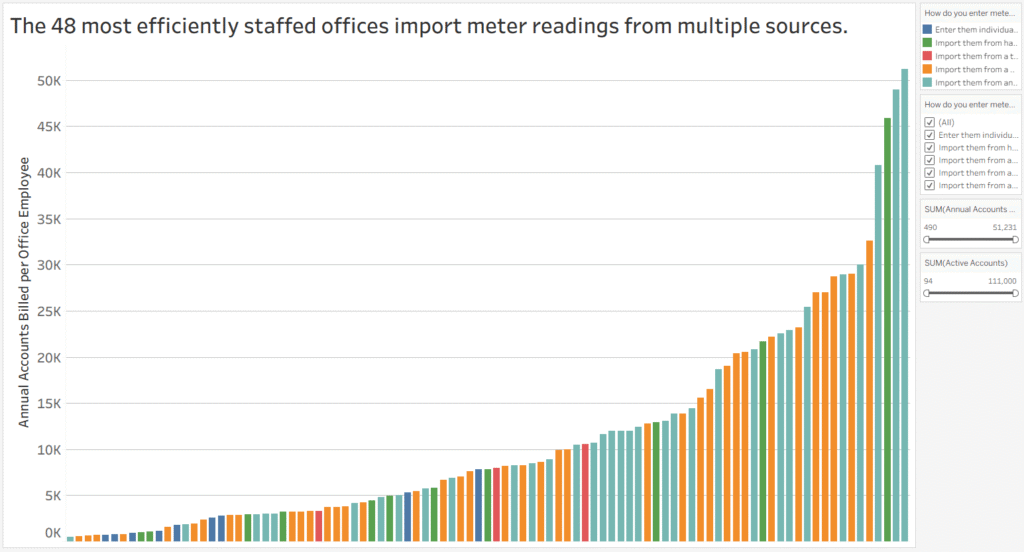
In terms of office staffing, the actual time savings with meter readings is only between manually entering readings or importing them from some sort of automated reading process.
As anticipated, most utilities that responded to the survey have automated their meter reading process. This year’s survey included nine utilities that still enter meter readings (representing 9.5% of responding utilities), down from 10 two years ago. Understandably, all nine of these utilities were in the bottom half of the most efficiently staffed offices, as shown in the graph below.
Meanwhile, AMI systems continue to gain popularity, with 33 utilities (34.7%) importing readings from AMI systems. This is up from 25.6% two years ago.
Bill printing
Bill printing and the related tasks required for preparing bills for mailing – separating postcards or folding and inserting full-page bills, sorting, and traying the mail – are labor-intensive tasks.
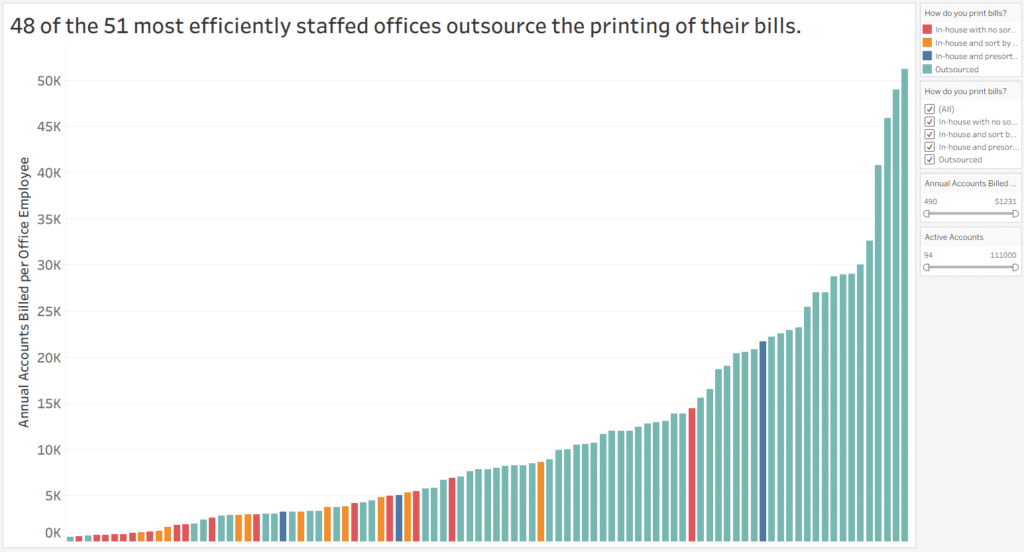
Outsourcing of bill printing continues to grow in popularity, with 65 utilities (68.4%) outsourcing the printing of their bills. Not surprisingly, the top 16 and 48 of the top 51 most efficiently staffed offices use an outsource printer to print their bills, as shown below:
Mail payment processing
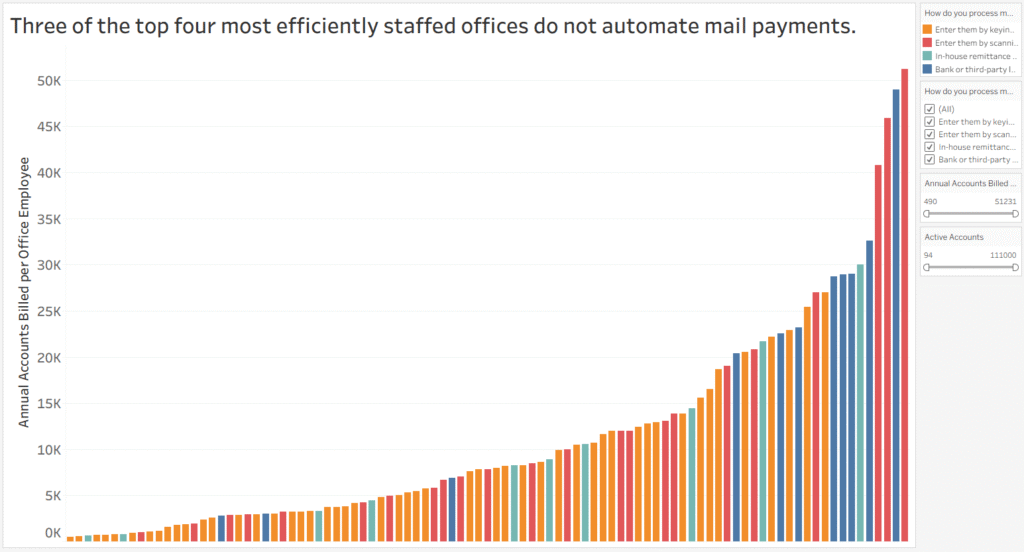
Mail payment processing is quite possibly the most laborious process in most utility offices. For that reason, many utilities have sought to automate the processing of mail payments, either by scanning barcodes on the bill, using a remittance processing system, or a bank lockbox.
Interestingly, a considerable number of utilities still enter payments by keying them. This year’s survey found 51 utilities (53.7%) manually entering payments. This is down from two years ago (62.8%), the highest of the four previous surveys.
Not surprisingly, 10 of the 13 most efficiently staffed utilities automate the mail payment process in some way, while 24 of the 28 least efficiently staffed utilities manually enter mail payments.
Phone credit card payments
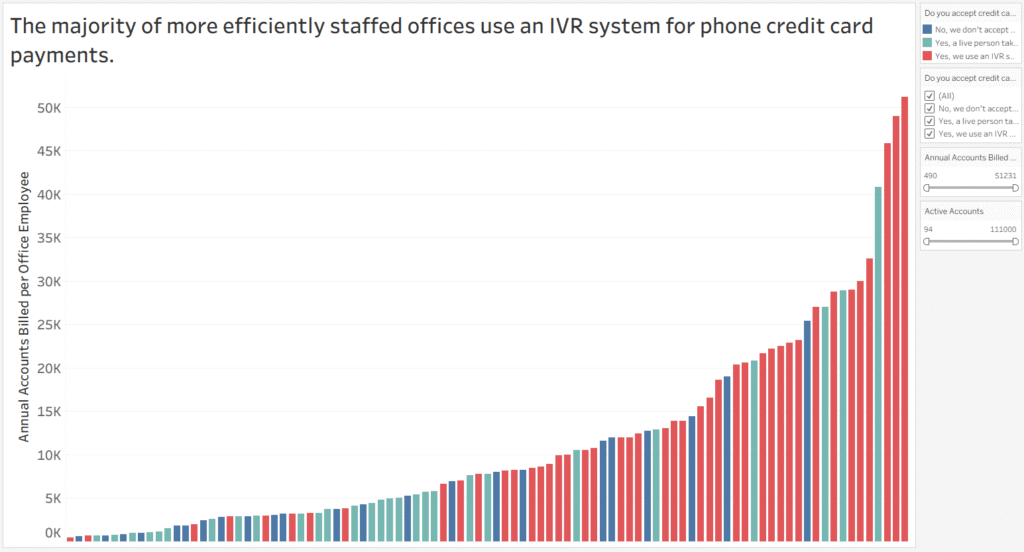
The next area the survey asked about is phone credit card payments. This can be an extremely laborious process if done by a person. The customer service representative must look up the account, inform the customer of the amount owed, take the credit card number, process the payment authorization, and finally enter the payment into the system.
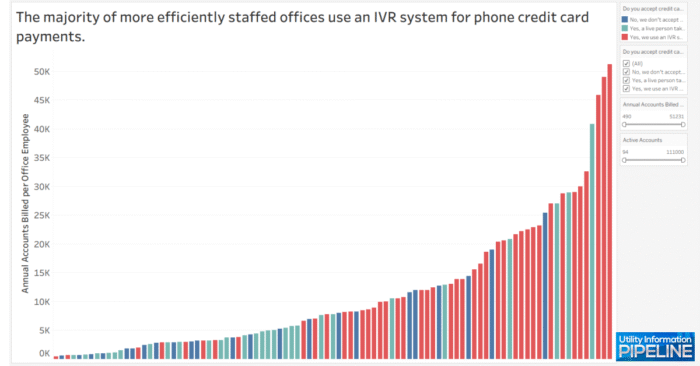
This year, for the first time, every utility responding to the survey accepts credit cards!
However, 23 utilities (representing 24.2%) don’t accept phone credit card payments. Of the rest, a live person takes the payment for 28 utilities (29.5%). and 44 use an IVR system (46.3%).
Once again, use of an IVR system continues to show a consistent, year-over-year increase since the inception of the Utility Staffing Survey. The use of IVR systems has increased each year, from 24.7% in 2016 to 46.3% this year.
If your office is still taking credit card payments in person, here’s a blog post explaining why this is not a good business practice.
Service order processing
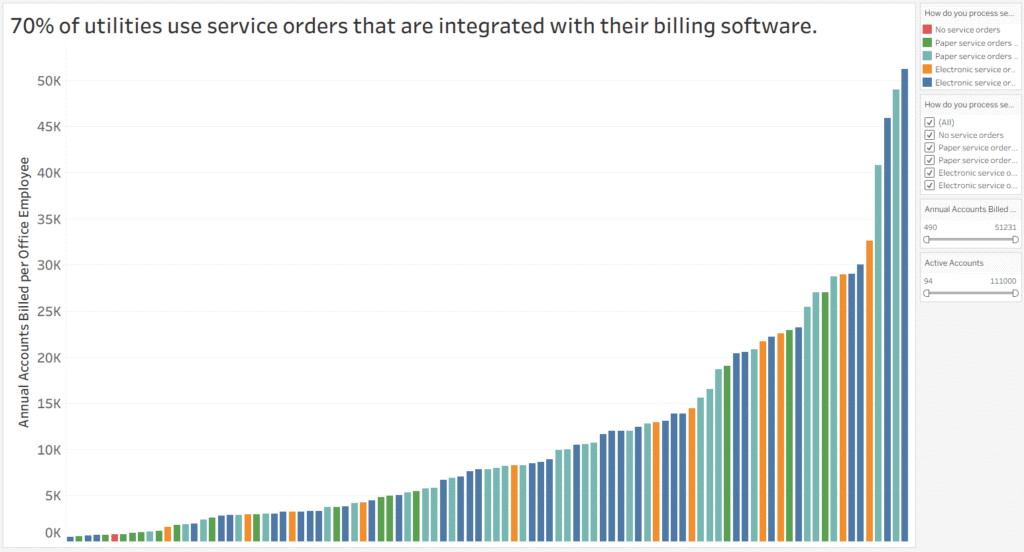
The final area of the survey is service order processing. The survey asked whether utilities used paper or electronic service orders and whether they were integrated with their billing software or not.
11 of the 13 most efficiently staffed offices use service orders that are integrated with their billing software, whether paper or electronic. 37 of the 95 utilities (representing 38.9%) use electronic service orders integrated with their billing software. This increased from 32.2% in 2024.
Is your office adequately staffed?
If you’re unsure if your business office is adequately staffed, this is one of the things I can advise you on after completing a business review. Please give me a call at 919-673-4050 or email me at gary@utilityinformationpipeline.com for more information.

© 2026 Gary Sanders