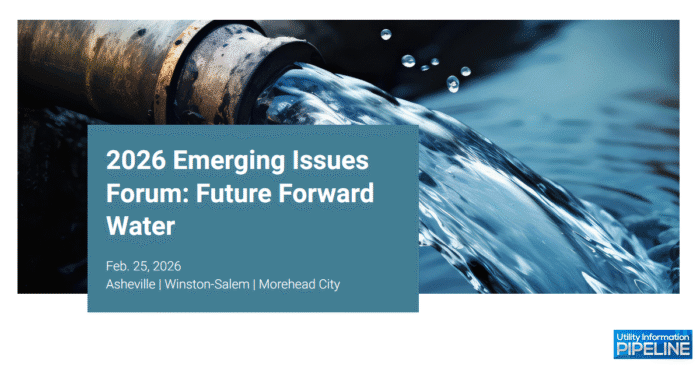
Two weeks ago, I had the opportunity to participate in the Emerging Issues Forum sponsored by the Institute for Emerging Issues at North Carolina State University. This year’s forum, Future Forward Water, “convened policymakers, experts, and other stakeholders to explore solutions to pressing challenges surrounding North Carolina’s water infrastructure.”
The Water Infrastructure Advisory Council drafted 21 strategies across six categories to address the challenges facing North Carolina water utilities. While the forum focused on North Carolina water utilities, I believe the strategies are equally relevant to utilities in other states.
Listed below are the six categories and the strategies for each category. You can learn more details about each strategy on the IEI website.
Promote Economically Viable Water Systems
- Strategy 1: Establish and maintain economically viable rate structures for water utilities
- Strategy 2: Raise awareness of the value of water and its related infrastructure
- Strategy 3: Promote customer assistance programs
- Strategy 4: Promote ways that water systems can reduce operational costs
- Strategy 5: Create additional local revenue options to pay for water infrastructure
- Strategy 6: Continue and accelerate the use of regional solutions to economically strengthen water systems
- Strategy 7: Increase and provide recurring state funding for water, wastewater, and stormwater infrastructure
Support Private Wells and Septic Systems
- Strategy 8: Promote the safe use of private wells and septic systems
Improve Planning, Land Use, and Water Infrastructure
- Strategy 9: Identify and implement water sector planning approaches that are forward-looking, holistic, and cross-jurisdictional
- Strategy 10: Ensure local land use decisions include consideration of impacts and accounting structures for water, including its related infrastructure
- Strategy 11: Protect water infrastructure against natural and manmade risks
Improve Water Policymaking
- Strategy 12: Promote informed policymaking action on the state’s water issues
- Strategy 13: Enhance the usability of existing water data
- Strategy 14: Collect more comprehensive data on water usage within basins and transfers across them
Promote Workforce Development
- Strategy 15: Identify “water sector” careers and related educational and training pathways
- Strategy 16: Raise awareness of water sector careers among learners, job seekers, families, and educators
- Strategy 17: Create effective models for education and training that address employer workforce needs
- Strategy 18: Fund effective models for education and training that address employer workforce needs
- Strategy 19: Ensure water workforce credentials are relevant
- Strategy 20: Remove barriers to obtaining water workforce credentials
Take Advantage of Economic Development Opportunities
- Strategy 21: Promote the development of new water technologies
Evaluation forms
At the conclusion of the forum, participants were asked to select their top three categories and the most important strategy in each category. My three choices were:
- Promote Economically Viable Water Systems and Strategy 1
- Promote Workforce Development and Strategy 16
- Improve Water Policymaking and Strategy 12
My first choice was a no-brainer. A recent survey of North Carolina water utilities found that only 20% of utilities had rates that funded future needs. In my experience, this phenomenon isn’t limited to North Carolina.
The second choice is due to a well-known nationwide problem: the aging workforce in the water and wastewater sector. A crisis is looming if we aren’t able to recruit younger workers to replace retiring, experienced workers.
My third choice is unique to North Carolina, where state law prohibits rate classes for residential customers. This means that affordability rates for low-income customers are illegal, and I feel strongly that needs to change.
What would your three choices have been? Feel free to leave a comment below.
Participate in the 2026 Utility Staffing Survey
If you haven’t already completed the 2026 Utility Staffing Survey and would like to, please click here to complete the survey.
Please feel free to share this survey with your peers at other utilities.
Thank you in advance for taking the time to complete the survey and for sharing it with other utilities.
What emerging issues does your office face?
If your office is facing issues or could operate more efficiently, please give me a call at 919-673-4050, or email me at gary@utilityinformationpipeline.com to learn more about how a business review could help you address them.

© 2026 Gary Sanders